
On Andrew Tate: PsyOp
The manosphere was infrastructure, not content. Men were targeted, not simply persuaded. The counter-structure is not better media. It is the institutions that were already missing.

What the engineering of the manosphere reveals about what was missing, and what it would actually take to build the alternative
What the New Yorker Actually Proved
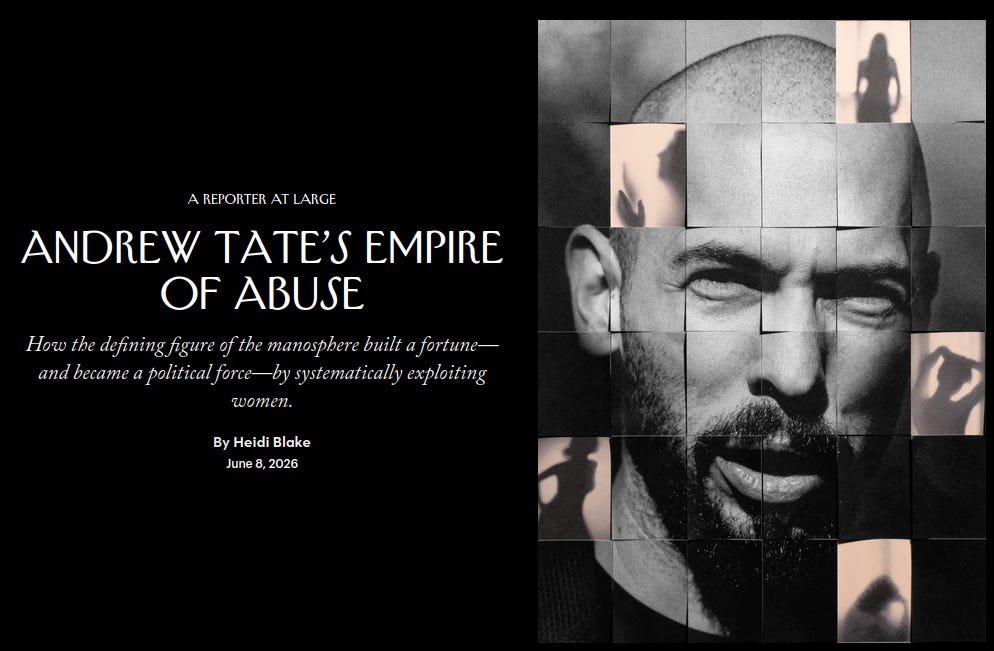
Heidi Blake’s New Yorker profile of Andrew Tate is a long piece of very careful reporting, and it establishes something more specific than its subject’s depravity. The depravity was already well documented. What the reporting adds is infrastructure.
The relevant facts, laid out without editorial comment in the piece, are these: Tate’s reach was not organic. It was engineered through Hustlers University’s affiliate content factory, which enrolled more than 160,000 students and paid them commissions to pump his videos into recommendation algorithms already primed for extreme content. Rumble, which received major investment from Peter Thiel and J.D. Vance, paid Tate a minimum of six million dollars a year under a confidential contract. His Twitter account was reinstated after Elon Musk’s acquisition. His Romanian travel ban was lifted following coordinated diplomatic pressure from U.S. officials, including Richard Grenell, whose involvement was confirmed by Romania’s own foreign minister. One of Tate’s lawyers was subsequently appointed White House liaison to the Department of Justice. His operation in Bucharest employed former members of Romania’s security services.
It is too easy to dress this up as a man who accidentally found an audience. When it is quite clearly a distribution system with a clownishly insufferable man at the center of it. The question of whether Tate understood his own function is interesting but structurally irrelevant. What matters is that the infrastructure existed, that it was funded by people now holding state power, and that it delivered a specific political output: the consolidation of men across a broad spectrum of ages, particularly economically precarious young men, into a coalition organized around the degradation of women and the restoration of authoritarian hierarchy.
I am rarely accused of subtlety, but just to be very clear, this is a psy-op argument, and honestly, if you read the Newyorker piece, and didn’t come to the very same conclusion, you should reread it, not this. I am not arguing that Tate was a government agent, or that there was a single coordinating intelligence. BUT, that genuine male distress was located, capital was deployed to process it, and the output was political. The men who were captured were not simply persuaded by bad ideas. They were targeted by a well-funded, deliberately engineered influence operation that found them where they were already vulnerable and converted their very real pain into fuel for a coalition that has no interest whatsoever in solving any of their actual problems.
That is the grief underneath my analysis, and I do mean grief, as the parent of young men. Those men were vulnerable and they were used. And now they are enclosed.
The Vacuum Preceded the Operation
Tate did not manufacture male loneliness, wage stagnation, or the collapse of working-class male belonging structures. He arrived after the demolition was already complete.
What collapsed, and when, matters for this analysis. The deindustrialization of the American working class accelerated through the 1980s and 1990s, eliminating not just wages but the institutional scaffolding that gave working-class men a legible social role: the union hall, the trade community, the stable workplace where seniority meant something, the factory floor where physical competence translated directly into recognized worth. The replacement economy offered service work, gig arrangements, and the management of your own brand as a substitute for all of it. None of these provide what the demolished institutions provided.
My Trust Envelope Model is precise about what was lost. It specifies five structural conditions of thriving: dignity, agency, accountability, cooperation, and adaptability. When any of these is genuinely absent, the system produces distress. What the demolished institutions had provided, imperfectly and unevenly, was a site where several of these conditions were operational simultaneously. A union shop gave men dignity in the structural sense: their labor had recognized worth, their vulnerability was not systematically used against them. It gave them cooperation: reciprocal structures where collective action produced real outcomes. It gave them accountability: procedures that constrained how management could treat workers, and how workers treated each other. It gave them adaptability: seniority systems and apprenticeship structures that provided a legible path through time.
The gig economy provides none of this. The algorithm that dispatches your next delivery does not recognize your dignity. The platform that sets your rate does not permit collective action. The content recommendation system that determines your reach does not owe you accountability. You are a unit of output, legible only as a metric, disposable without process.
This is the vacuum. It is not a cultural problem or an attitude problem. It is a structural deficiency in the institutions that working-class men actually inhabit. The manosphere did not create the deficiency. It found men living inside it and offered a replacement system. The replacement system was counterfeit on every dimension, but the counterfeits were targeted precisely at what was missing. The manosphere offered a replacement dignity system: you are legible, you matter, you have a rank. It offered replacement cooperation: brotherhood, the gym community, the War Room. It offered replacement accountability: the elaborate codes of masculine conduct, the rankings and the disciplines. The counterfeits held because the underlying deficiencies were real.
What the Operation Actually Sold
The New Yorker piece is most useful not in its documentation of Tate’s crimes, which are extensive and well evidenced, but in its account of the actual product he was selling to the men who paid to consume it.
Hustlers University was not primarily a get-rich-quick scheme, though it was that too. The War Room was not primarily a webcam recruitment pipeline, though it was that as well. What both products were selling, at their functional core, was identity. Specifically: a self that had escaped listlessness, that had achieved legibility in a system that recognized worth, that belonged to something with real stakes and real brotherhood.
The New Yorker details the War Room’s internal culture in detail. Members were inducted through elaborate ritual. They received required reading, including a pimping manual, and were assigned to group structures with titles: the Great Hall, the Master of Scrolls and Decorum. They gathered at summits in castles in Transylvania. A California hypnotist named Miles Sonkin, who billed himself as an expert in neurolinguistic programming, taught them to install “spells” during sex, to keep women “soul-locked.” Members earned status by sharing evidence of their conquests and their recruits.
SIDE NOTE: In a world where someone is calculating the ROI on women’s orgasms, no souls were are at risk of being locked.
This is a fusion construct with a criminal enterprise at its center, and a splash of ideological Hai Karate. This distinction must be made before understanding what counter-structures would need to provide. The men who paid to participate were not buying a business education. They were buying membership in a community with authentic-feeling stakes, a legibility system that told them where they stood, rituals that marked belonging, and a self that was finally recognizable as meaningful. All of this is the apparatus of Identity Fusion: the process by which a belief system stops being held as a proposition and starts being inhabited as a self.
Once fusion occurs, critique of the movement does not reach the man as an argument to evaluate. It reaches him as an attack on who he is. This is why the men Lewis interviews who can articulate the movement’s contradictions still cannot exit it. This is why the War Room members who expressed discomfort at the most extreme violence were not moved to leave. The self had already moved in. Dismantling the construct would require dismantling the self, which no argument, no matter how compelling, can accomplish.
The operation was engineered to produce exactly this. The recruitment funnel, the progressive disclosure of increasingly extreme content, the ritual structure, the escalating commitment requirements, the controlled brotherhood with its hierarchies and its summits: these are not incidental features of a content business. They are the architecture of a fusion factory, built and funded by people who understood what they were building.
Why the Rogan of the Left Fails
The obvious response to a well-funded right-wing media operation aimed at young men is a well-funded left-wing media operation aimed at young men. This response is wrong, and I am going to get very specific about why.
The failure mode here is not ideological. A progressive podcast hosted by a charismatic man who validates male grievances, names the structural causes of male distress, and gives listeners a leftist identity to inhabit instead of a reactionary one would not be a counter-structure. It would just be a counter-refinery running the same fusion physics with different fuel. The output would still be men whose sense of self is fused with a parasocial construct, dependent on a charismatic center, susceptible to the same enclosure dynamics at a different political pole.
The problem with the manosphere is not that it produced right-wing men. The problem is that it produced fused men: men whose capacity for independent judgment was replaced by a legibility system owned by operators who were using them. A progressive version of this would produce fused men with better politics, which is only marginally better, and would leave the underlying structural problem entirely intact.
The other failure mode is the therapeutic response: more mental health resources, more conversations about male loneliness, more encouragement for men to be vulnerable. This is not wrong as a component, but it misidentifies the level at which the problem operates. The male loneliness crisis is not primarily a psychological problem. It is a structural problem that produces psychological symptoms. Treating the symptoms without addressing the structure is the equivalent of giving dignity coaching to workers in a genuinely undignified workplace. The coaching does not change the conditions. It just improves the individual’s capacity to tolerate them.
What both failure modes share is the substitution of shallow content for real structure. The manosphere won because it occupied a structural vacuum, not because it had superior content. The answer to a vacuum is not better content into the same vacuum. The answer is a wholly different structure.
What Authentic Friction Actually Requires
The Trust Envelope framework distinguishes between counterfeit friction and authentic friction. Counterfeit friction is the kind the manosphere specializes in: lifting rituals without community, dashboards of rank without reciprocal accountability, purges of outsiders, harassment campaigns that require participation to prove loyalty. These frictions produce belonging, but the belonging is brittle. It is maintained by repression rather than reciprocity, and it collapses into violence when the repression pressure drops.
Authentic friction is different in its physics. What costs nothing means nothing. Meaning is produced through difficulty, attachment is secured through cost, credibility is anchored in friction. But the friction must be proportionate, transparent, and aligned with genuine stakes. The craft apprenticeship that requires years of real skill development before mastery is recognized produces authentic belonging because the cost is real and the recognition is earned. The union that requires members to show up, take risks, and bear collective costs to achieve collective outcomes produces authentic cooperation because the reciprocity is structural, not performed.
This points to a specific category of institution as the counter-structure: not media products, not therapeutic services, not even progressive content, but organizations that provide men with real stakes, real reciprocity, real accountability, and real recognition of competence. The historical examples are instructive because they are unfashionable, and probably kind of boring.
Labor unions, at their functional best, provided exactly the TEM invariants the manosphere counterfeits. Dignity: your labor had recognized worth, you could not be arbitrarily dismissed without process. Agency: collective bargaining meant that your working conditions were not unilaterally imposed. Accountability: grievance procedures gave the powerless a real mechanism for contesting the powerful. Cooperation: the strike fund, the solidarity obligations, the recognition that individual protection depended on collective maintenance. Adaptability: apprenticeship structures and seniority systems provided a legible path through working life. The union hall was also a physical space, which is not incidental. It was a place where men gathered, argued, built relationships, and formed identities through shared stakes rather than shared content consumption.
Trade and craft communities work by similar mechanics. The mastery hierarchy in a skilled trade is a legibility system, but one that is earned through real competence rather than purchased through subscription fees. The journeyman who becomes a master has been assessed by people with genuine expertise, in conditions with genuine stakes. The recognition is not counterfeit. It cannot be revoked by the algorithm or withdrawn by the platform. It is embedded in real relationships with real people who have worked alongside you and evaluated you against standards that exist independent of any individual’s desire for status.
Cooperative structures, from worker cooperatives to credit unions to mutual aid networks, provide the accountability invariant in a form that the manosphere cannot replicate. When you are a partial owner of the enterprise that employs you, the accountability relationship runs in both directions. Your voice in governance is not a UI feature or a performance of participation. It is a real mechanism that can change real outcomes. The friction of actual democratic governance, the meetings, the disagreements, the slow work of collective decision, is exactly the kind of authentic friction that produces durable belonging.
None of this is romantic. Unions have been corrupt. Trades have been exclusionary, and the exclusions have often been organized by race and sex. Cooperatives fail at rates comparable to conventional firms. The point is not that these structures are inherently virtuous. The point is that they are structurally capable of producing the TEM invariants through authentic friction, and that this capability is what makes them counter-refineries. The manosphere cannot replicate them because it cannot provide real stakes, real reciprocity, or real accountability. It can only provide the simulation of these things, and the simulation requires escalating extremism to maintain its affective charge.
Why This Is Feminist Work
Stay with me, I am not saying it’s women’s work to solve men’s problems. The argument for rebuilding male belonging structures is sometimes framed as charity toward men, or as a concession to the grievance politics the manosphere has normalized. This framing is very wrong about the political logic.
The same institutional collapse that stripped working-class men of dignity structures also created the political conditions for the coalition that is now actively dismantling women’s rights. These are not separate problems connected by proximity, but the very same load-bearing failure.
The manosphere’s capture of economically precarious men was not accomplished by persuading them that feminism was wrong. It was accomplished by finding men who were already living in a structural vacuum and offering them a replacement structure organized around the degradation of women as its central adhesive. Helen Lewis documents this in her Atlantic piece: the movement is ideologically incoherent on everything except gender. Trade policy, foreign policy, technology regulation, all of this is contested within the coalition. The contempt for women’s advancement is the only thing that holds the factions together.
The adhesive function of misogyny in this coalition is not accidental. A movement that has no genuine interest in solving the labor market problems, the loneliness crisis, or the institutional belonging deficits that drove men into the refinery in the first place needs a substitute explanation for male distress. The substitute explanation is women: women took your jobs, women degraded your status, women changed the rules. This explanation is false as causal history but functional as political adhesive. It gives men a target for their genuine distress that does not implicate the real capital structures that actually produced it.
This means that building authentic male belonging structures is not a concession to the movement’s frame. It is a direct attack on the movement’s fuel supply. Men who have genuine dignity structures, genuine cooperation structures, genuine accountability and recognition in their working and civic lives do not need the manosphere’s counterfeit versions. The refinery requires surplus, unanchored affect1 to process. Remove the surplus by addressing the structural deficiencies, and you remove the raw material.
The feminist structural analysis of this moment therefore includes the labor question, the cooperative economy question, the trade and craft revival question, and the civic institution question, not as peripheral concerns but as central ones. The women’s rights rollback currently underway was enabled by a political coalition assembled from male distress that was left unaddressed by institutions that should have been maintaining it. Addressing that distress now is not separate from the work of defending those rights. It is part of the same project.
adrienne maree brown’s frame is useful here: we are all trying to figure out how to be in right relationship with each other and with the conditions of our lives. The manosphere offers men a wrong relationship with women as the price of belonging. The counter-structure offers men right relationship with each other and with work as the basis of belonging. These are not equivalent arrangements. One is organized around extraction, the other around reciprocity. It is thermodynamic.
How the Hell Do We Move Forward
The structural diagnosis points to specific interventions at specific levels. None of them require a charismatic center. All of them require sustained institutional work. Start small, work local, but please consider any of these suggestions, or let me know if you have better ones.
At the policy level, the labor question is not separable from this analysis. Wage floors that make working-class labor legible as dignified work, sectoral bargaining frameworks that restore collective agency to workers who currently have none, portable benefits structures that detach dignity from the whims of individual employers: these are not abstractions. They are the material conditions under which authentic belonging structures can form. Institutions cannot provide TEM invariants to men whose economic conditions have stripped those invariants out before they arrive at the door.
At the organizational level, the revival of worker ownership models deserves serious attention from people who are not currently giving it. Worker cooperatives, employee stock ownership plans with genuine governance rights, platform cooperatives that give gig workers collective ownership of the infrastructure they depend on: these are operating counter-refineries. They exist, they function, and they provide exactly the accountability and cooperation structures that the manosphere simulates. They require capital, legal infrastructure, and sustained organizational support. The progressive funding landscape has underinvested in them dramatically relative to media and advocacy work.
At the community level, the physical space problem is real and underaddressed. The union hall, the trade hall, the cooperative meeting room: these were sites where men gathered in person, with real stakes, and formed real relationships through shared work and shared conflict. The collapse of these spaces was not reversed by social media. Online community is not a substitute for physical presence. The men who were most vulnerable to the manosphere’s recruitment were men who had no physical sites of belonging. Building them back requires investment in the unglamorous infrastructure of civic life: the community workshop, the cooperative kitchen, the mutual aid network with a real address.
At the individual level, the most useful thing a person with institutional access can do is extend it. The manosphere’s recruitment operated through personal relationship: Tate’s affiliate network, the War Room’s personal sponsorship structure, the love-bombing that preceded every recruitment. The counter-structure does not need to replicate the manipulation, but it does need to replicate the personal contact. Mentorship in skilled trades, sponsorship into cooperative structures, direct invitation into civic institutions with genuine stakes: these are how people exit fusion constructs. Not through argument, but through the availability of an alternative site of self-formation that is real enough and proximate enough to be inhabited.
The ending the manosphere offers men is a self fused with a construct that requires their ongoing participation in the degradation of women to maintain its charge. The alternative ending is a self formed through genuine friction, genuine reciprocity, genuine recognition. That self does not need the counterfeit. It already has the real thing.
The refinery was built because the vacuum existed. The vacuum can be filled. Not by better content, not by a progressive version of the same machinery, but by the patient, structural, unglamorous work of building the institutions that provide what was missing: dignity that is structural, cooperation that is reciprocal, accountability that runs in both directions, belonging that does not require anyone else’s degradation as its condition.
That is the work. It does not have a charismatic host. It does not trend. It compounds.
Affect = Emotions, you definitely have emotions.
Thank you. I needed to read this right now.
Reading this prompted me to reach out to several men to ask for help with a project to help our community. (We need prototypes for a class on DIY ways to cook / preserve food and filter water with the sun rather than electricity - a picture frame solar dehydrator, a cardboard oven and a solar still)
Because mutual aid is one of those paths to community, dignity, agency, and recognition for skill - but to date we’ve been largely females showing up for the activist work. Lure the dudes in with achievable small projects, and suddenly they will be up to their necks in helping our neighbors! 😄
Benevolent scheming, to heal our world.
I watched this play out in the martial arts world over the course of ten years. I can't go to classes anymore, in no small part because I can't stand the MAgA-loving stupidity that has taken over that world. It sucks.